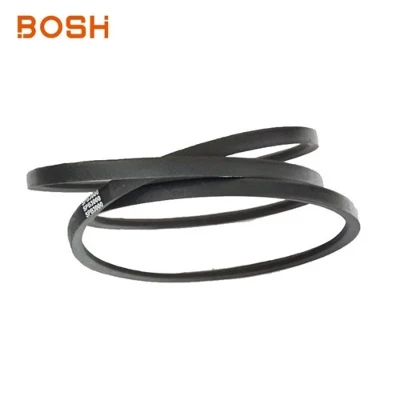
The performance and service life of a multi-ribbed belt depend not only on the rubber compound used in its manufacture but also on the design of the complete belt structure. Different functional layers work together to withstand tension, friction and repeated bending during operation. This structural approach allows multi-ribbed belts to meet the requirements of automotive, agricultural and industrial power transmission systems.
The most distinctive external feature is the series of continuous longitudinal ribs formed along the working surface. These ribs run parallel to the length of the belt and engage with matching grooves on the pulley. As the belt moves around the drive system, the ribs remain engaged with the pulley grooves and generate the friction required to transfer rotational power. Multiple ribs work simultaneously, creating a continuous contact area between the belt and pulley.
Inside the belt, different functional layers contribute to overall performance. The rubber body provides flexibility and forms the primary working structure of the belt. It must withstand repeated bending and contact with the pulley while maintaining its shape during operation. The tensile layer, positioned within the belt structure, is responsible for carrying much of the tension generated during power transmission. Reinforcing materials are selected according to the intended application to provide the required strength and dimensional stability.
The connection between the ribbed section and the internal tensile structure is also important. A well-integrated belt construction helps maintain structural integrity when the belt operates at high speed or passes repeatedly around pulleys. Poor structural design or manufacturing quality can contribute to rib wear, deformation or loss of tensile performance, which may eventually affect the reliability of the entire drive system.
Some multi-ribbed belts are designed to allow the back surface to run against tensioners or additional pulleys. This configuration can be useful when the belt must follow a complex routing path around multiple components. By allowing greater flexibility in belt routing, the design can help engineers make better use of limited installation space.
The relatively thin profile and continuous rib structure also give multi-ribbed belts good bending flexibility. This allows them to operate around smaller pulleys and accommodate more compact drive arrangements. However, the pulley dimensions and belt specifications still need to be properly matched to prevent excessive bending stress and premature wear.
A multi-ribbed belt is therefore more than a simple rubber loop. Its ribbed working surface, rubber body, tensile reinforcement and, where required, back-side construction form an integrated transmission system. The interaction between these structural elements determines how effectively the belt can handle load, maintain flexibility and deliver stable power transmission.
As modern machinery continues to place greater emphasis on compact and efficient drive systems, structural design will remain an important factor in the development of multi-ribbed belts. Optimizing the relationship between belt materials, reinforcement and rib geometry can help provide reliable transmission performance across a wide range of applications.