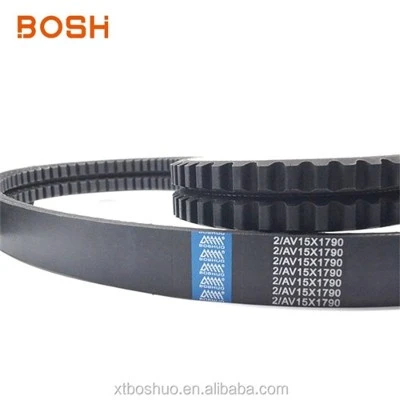
In mechanical equipment, power must often travel through several transmission components before reaching the final driven mechanism. Timing belts play an important role in this process by combining a flexible belt body with a toothed profile that supports controlled power transfer and synchronized movement. Unlike conventional friction belts, timing belts engage directly with toothed pulleys, creating a defined mechanical connection between the driving and driven components.
Power transmission is the fundamental role of a timing belt. When a motor, engine or other power source rotates the driving pulley, the pulley teeth engage with the belt and move it along the transmission path. The belt then engages with the driven pulley, converting its linear movement into rotational motion at the output shaft. This provides an efficient and practical connection between separate rotating shafts.
Maintaining a consistent transmission relationship is another major function. The belt teeth and pulley grooves are manufactured according to a defined pitch, allowing the belt to follow a controlled movement pattern when properly installed and tensioned. Compared with friction-based belt drives, this positive engagement reduces the influence of slip and helps maintain synchronization between the driving and driven components.
Timing belts are particularly useful for coordinating movement in automated machinery. Conveyors, positioning mechanisms and machine actuators may need to operate according to specific timing and positional relationships. By selecting an appropriate belt specification and pulley ratio, engineers can coordinate multiple moving elements and support repeatable mechanical cycles.
Controlling the transmission ratio is also an important application of timing belt systems. The number of teeth on the driving and driven pulleys determines their relative rotational speeds. By selecting pulleys with different tooth counts, designers can establish the required speed relationship and adapt the drive system to different equipment requirements.
Because a timing belt is a flexible transmission element, it can also provide a degree of mechanical compliance. The belt can undergo limited elastic deformation during operation and absorb part of the effect of transient load changes. This flexibility can provide a useful buffer within the drive system compared with completely rigid transmission arrangements.
The compact nature of belt-and-pulley systems can also be beneficial where equipment space is restricted. With appropriate pulley placement and tensioning arrangements, timing belts can accommodate a range of drive layouts while maintaining positive engagement.
The ability of a timing belt to perform these functions depends on correct component selection and installation. Belt dimensions, tooth profile, pulley compatibility, alignment and tension all influence transmission performance. Tooth wear, incorrect tension or pulley misalignment can affect engagement and should be addressed through regular inspection and maintenance.
Timing belts therefore serve several important purposes beyond basic power transmission. They support synchronized motion, controlled speed ratios, coordinated mechanical movement and a degree of flexible load absorption. These capabilities have made timing belts an established solution for automotive systems, industrial automation, packaging equipment, CNC machinery and precision drive applications.
As modern machinery continues to demand more accurate and repeatable motion, timing belts will remain an important option for mechanical transmission systems that require dependable synchronization and controlled power transfer.