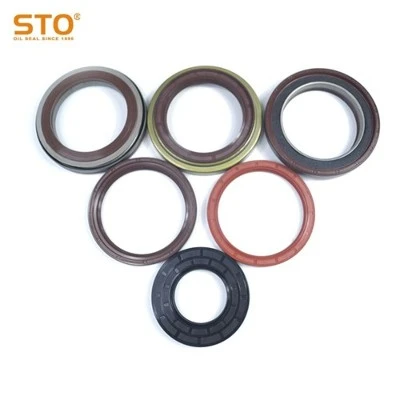
Sealing performance is essential to the reliability and efficiency of hydraulic systems, pneumatic equipment, automotive components, industrial machinery and fluid-handling systems. O-rings are among the most widely used sealing elements because of their simple design and versatile performance. Typically installed between mating components, an O-ring deforms within a groove to maintain contact with the surrounding surfaces and create a sealing barrier under both static and selected dynamic conditions.
Preventing fluid and gas leakage is the primary function of an O-ring. During installation, the O-ring is compressed between the groove and the mating surface, creating an initial sealing force. When system pressure increases, the elastomer can be pushed further against the sealing surfaces. With the correct groove design, material and operating conditions, this contact helps prevent the working medium from escaping through the clearance between components.
Separating different areas within a system is another important function. In hydraulic equipment, O-rings help retain hydraulic fluids within designated passages and chambers. In pneumatic systems, they help reduce the loss of compressed air. By maintaining separation between internal spaces, O-rings contribute to stable pressure and reliable system operation.
O-rings can also accommodate certain changes in operating pressure. As pressure fluctuates, the sealing element needs to maintain sufficient contact with the mating surfaces. Proper selection of elastomer hardness, cross-sectional diameter and groove geometry can help the O-ring maintain effective sealing within its intended pressure range. In higher-pressure applications, backup rings may be used to provide additional support and reduce the risk of extrusion.
Limiting the entry of external contaminants can also be an important function. Dust, moisture and other contaminants may affect internal bearings, precision components or lubricated surfaces if they enter through a connection or housing interface. A properly installed O-ring can create a protective barrier that helps isolate the internal system from the surrounding environment.
O-rings are also valued for their simple construction, convenient installation and broad application range. Their circular cross-section allows them to provide sealing contact around a variety of interfaces, including grooves, end faces, flanges and fluid connections. Different elastomer materials can be selected according to the operating fluid, temperature, pressure and environmental conditions.
In practical applications, sealing performance depends heavily on correct installation and system design. An unsuitable groove, damaged sealing surface or twisted O-ring can compromise the seal. Selection should therefore take into account the required inside diameter, cross-section, material, hardness, operating temperature and chemical compatibility.
Although an O-ring is a relatively simple component, its role within a mechanical system is significant. By helping prevent leakage, separate internal media, maintain pressure and reduce contamination, O-rings provide an effective sealing solution across a wide range of industrial applications.
Their combination of simple geometry, flexible material options and broad usability has made O-rings a fundamental sealing component in modern hydraulic, pneumatic, automotive and industrial equipment.