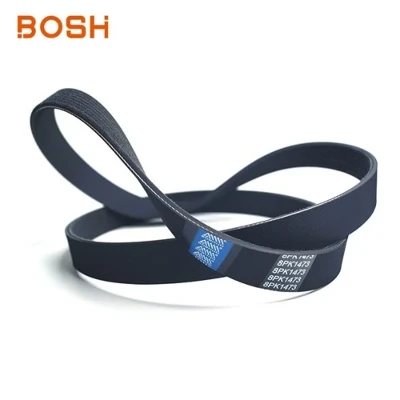
As mechanical equipment places increasing demands on transmission reliability and durability, belt manufacturers continue to develop different material and construction solutions for demanding applications. A wrapped belt is a type of power transmission belt characterized by a fabric covering applied around the outer surface of the belt body. This covering provides an additional layer of protection while allowing the belt to perform its intended transmission function.
The defining feature of a wrapped belt is its external textile covering. Instead of leaving the rubber body directly exposed, the belt is surrounded by a layer of fabric that forms a protective outer surface. The covering material is typically selected for its strength, wear resistance and ability to withstand repeated contact with other mechanical components. It is integrated with the underlying belt structure during manufacturing to create a unified construction.
The fabric covering serves more than a protective purpose. It can also influence the friction and surface characteristics of the belt during operation. When the belt comes into contact with pulleys or other components, the outer covering helps shield the rubber body from direct mechanical contact. This can be particularly useful in applications where the belt is exposed to continuous friction or challenging operating conditions.
A wrapped belt generally combines several functional elements within one construction. The rubber body provides flexibility and supports the basic mechanical properties of the belt. Internal reinforcement carries the tensile loads generated during operation, while the outer fabric covering provides surface protection and contributes to the belt's overall durability. The materials and construction can be adjusted according to the intended application.
Wrapped belts are used across a range of mechanical equipment, including agricultural machinery, industrial systems and general-purpose drive applications. Agricultural equipment may expose belts to dust, vibration and changing temperatures over extended operating periods. In such conditions, the protective covering can provide an additional barrier around the belt body. Certain industrial drive systems may also use wrapped belts when their operating conditions call for a covered belt construction.
Wrapped belts are not limited to a single specification. Belt dimensions, profiles, reinforcement materials and covering configurations can vary according to the requirements of the application. When selecting a wrapped belt, users should consider factors such as equipment type, pulley dimensions, transmitted power, operating speed and environmental conditions rather than relying solely on the belt's appearance.
In practical terms, a wrapped belt can be described as a composite transmission belt with a protective textile covering around its outer surface. By combining a rubber body, reinforcing elements and an external fabric layer, the design provides both power transmission capability and additional surface protection.
As mechanical equipment continues to operate in increasingly diverse environments, wrapped belts remain a useful solution for drive systems where surface durability, environmental resistance and dependable operation are important considerations. Proper material selection and compatibility with the surrounding pulley system are essential for achieving reliable long-term performance.