Timing belts are widely used in automotive systems, industrial machinery, automation equipment and precision drive applications. Unlike conventional belts that rely primarily on friction, timing belts feature molded teeth that engage with matching grooves on toothed pulleys. This construction gives them distinctive characteristics in terms of synchronization, transmission accuracy and operating stability.
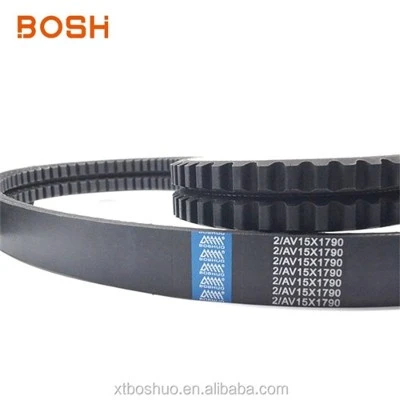
The toothed profile is the defining feature of a timing belt. Its working surface contains evenly spaced teeth manufactured to a specific pitch, which must correspond accurately with the grooves of the mating pulley. Different tooth profiles and pitches are designed for different drive systems, making proper belt and pulley compatibility essential for reliable operation.
Synchronous motion is one of the most important characteristics of timing belts. Because power is transferred through positive tooth engagement rather than depending primarily on friction, the belt is less susceptible to the type of slip associated with conventional friction drives. This makes timing belts particularly suitable for equipment where the relative movement between rotating components needs to remain controlled.
Transmission accuracy is another important characteristic. Tooth pitch, tooth geometry and overall belt dimensions need to remain consistent so that the belt can maintain proper engagement with the pulley. In automation and precision machinery, this controlled engagement helps support repeatable movement and consistent operating cycles.
Despite their toothed construction, timing belts remain flexible transmission components. They can bend continuously as they travel around pulleys, allowing them to accommodate a variety of drive layouts. Appropriate material selection and structural design help the belt withstand repeated flexing while maintaining its intended geometry.
Internal reinforcement is another important part of timing belt construction. High-strength tensile cords are commonly embedded within the rubber or polymer body to carry the primary tensile loads generated during operation. The reinforcement helps limit excessive elongation and supports the dimensional stability required to maintain accurate tooth engagement.
Timing belts can also provide a relatively compact transmission solution. Their positive engagement with toothed pulleys allows power and motion to be transferred within a controlled belt-and-pulley arrangement, which can be advantageous where installation space is limited. Depending on the belt design and operating conditions, timing belt systems can also offer relatively low maintenance requirements and controlled operating noise.
The fundamental characteristics of timing belts therefore include positive tooth engagement, synchronous transmission, dimensional accuracy, flexibility and reinforced load-carrying construction. These properties make them suitable for a wide range of automotive, industrial, automation and precision applications.
As modern machinery places increasing emphasis on accurate motion control and dependable power transmission, advances in belt materials, tooth geometry and reinforcement technology are expected to further improve timing belt performance and expand their role in sophisticated drive systems.