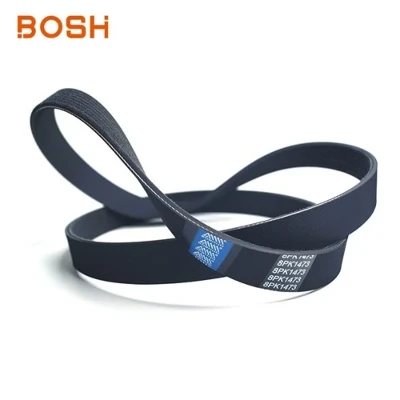
Timing belts play an important role in modern mechanical drive systems by transferring rotational motion from one shaft to another through positive engagement between belt teeth and matching pulley grooves. Unlike friction-based belt drives, this arrangement provides a defined mechanical relationship between the belt and pulley, making timing belts well suited to applications that require synchronized movement.
The operating process begins when a motor, engine or other power source rotates the driving pulley. As the pulley turns, its grooves engage with the corresponding teeth on the belt. The engagement creates a driving force that moves the belt along its transmission path. The belt then carries this force from the driving side toward the driven pulley.
When the moving belt reaches the driven pulley, its teeth enter the corresponding grooves and transfer the belt's motion back into rotational movement. This continuous engagement allows the input torque from the driving shaft to reach the driven shaft while maintaining a controlled relationship between the two rotating components.
The belt does not experience identical loading on both sides. The tension side, commonly known as the tight side, carries most of the effective tensile load during power transmission, while the opposite side experiences lower tension. Correct belt tension is essential because it helps maintain consistent tooth engagement and reduces the risk of tooth jumping under changing load conditions.
Internal tensile reinforcement is another important part of the operating process. Reinforcing cords or other high-strength materials carry a substantial portion of the tensile load and help limit elongation over time. Maintaining a stable pitch is particularly important for synchronous transmission because significant changes in belt geometry can affect the relationship between the belt teeth and pulley grooves.
While transmitting power, the belt also repeatedly bends as it travels around the pulleys. The belt body therefore needs sufficient flexibility to withstand repeated bending cycles while maintaining its mechanical integrity. Material selection and structural design influence fatigue resistance, making it important to match the belt construction to the speed, load and operating cycle of the equipment.
Pulley alignment, center distance and pulley diameter can also affect belt performance. Poor alignment may cause the belt to track incorrectly and create localized wear. For this reason, reliable timing belt operation depends not only on selecting the correct belt specification but also on maintaining accurate installation and proper pulley alignment.
The working process of a timing belt can therefore be understood as a continuous sequence of tooth engagement at the driving pulley, tensile force transfer through the belt and positive engagement at the driven pulley. Tooth geometry, internal reinforcement and controlled tension work together to maintain synchronized movement.
As machinery increasingly demands accurate motion control and dependable power transmission, timing belts continue to provide an effective solution for systems where synchronization and repeatable mechanical movement are essential.